Natural Scenes Dataset
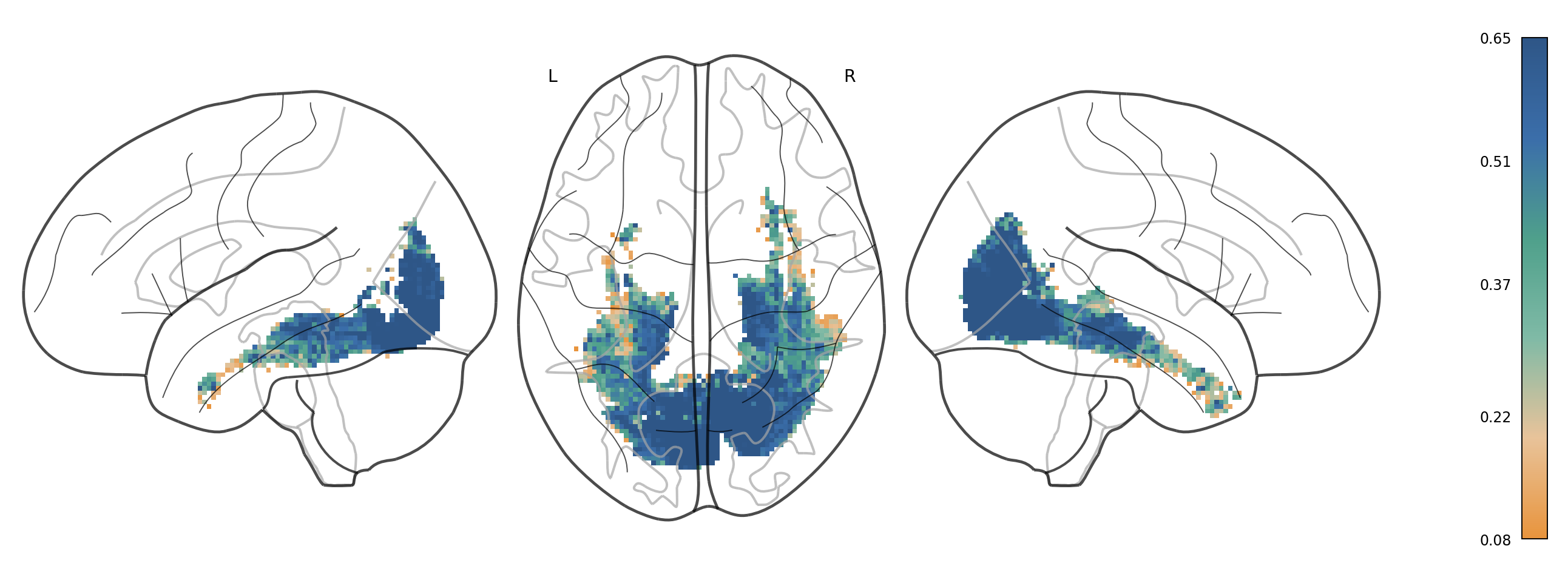
People viewed thousands of natural images while fMRI measured activity across the visual cortex.
- 9k
- training images
- 1k
- held-out images
Microsoft Research · visual neuroscience · July 2026
We let agents write fixed visual models from scratch. Held-out neural predictivity decides which ideas survive.
The question
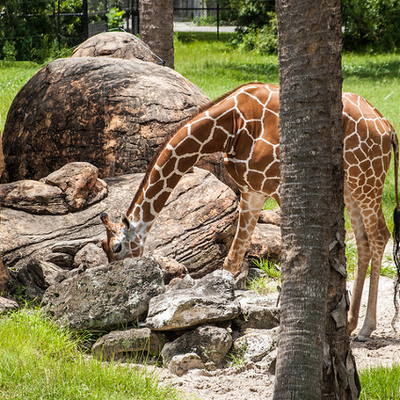
Visual neuroscientists often start with a network trained for another task, then ask how well its features predict neural activity. We reverse that process. The neural data define the objective, and agents search directly for the function.


 ŷneural prediction
One input, two measurement scales
People viewed thousands of natural images while fMRI measured activity across the visual cortex.
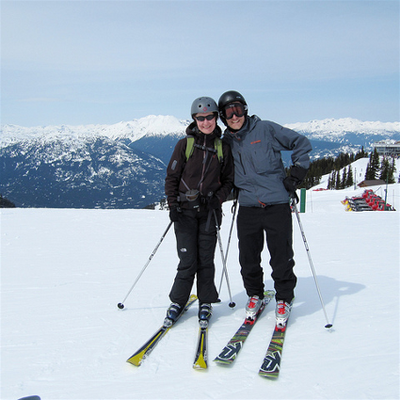
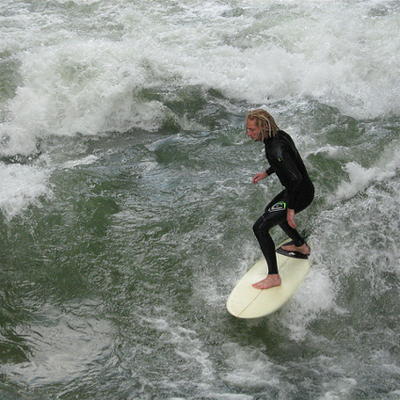
Five macaques viewed 1,000 NSD images while dense probes recorded single-neuron responses.
Why search architecture?
Even random CNN features predict more neural variance than a random projection. ImageNet training improves them further. This leaves a precise question: can search find better fixed computations without training?
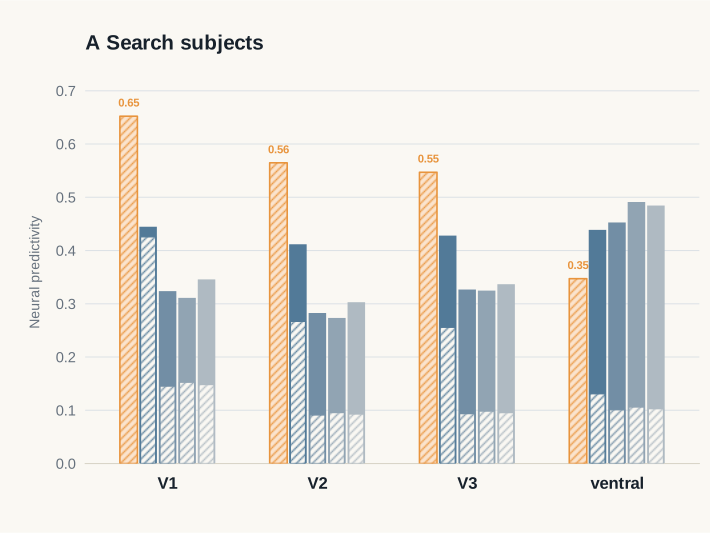
Noise-normalized explained variance, averaged across each dataset’s search cohort.
The method
Each proposal is executable code for a fixed function, f(X). The harness freezes everything else: the dataset, readout, held-out split, and scoring rule.
The model never reads neural targets and never updates weights. It can only improve by proposing a better computation.
An agent writes or revises model.py.
A fixed evaluator fits the same linear readout and measures held-out predictivity.
The score returns as feedback. The agent keeps, changes, or replaces the idea.
def model(x):
  gabor = quadrature_energy(x)
  complex_cells = local_max(gabor)
  colour = opponent_energy(x)
  parts = part_gram(complex_cells)
  return pool(gabor, colour, parts)
Fixed constraints
Every proposal is inspectableThe search
Independent search lineages evolve separate model families. A conductor shares broad directions without forcing every lineage toward the current winner, preserving the diversity needed to discover different mechanisms.
No lineage is required to copy the current best model.
The evaluator, data split, and readout remain fixed.
Agents can combine, revise, or discard visual mechanisms.
The result
The search converged on an HMAX-like energy model built from familiar cortical motifs: oriented filters, phase-invariant complex cells, normalization, colour opponency, local pooling, and part–whole statistics.
NSD · July 17 evaluation
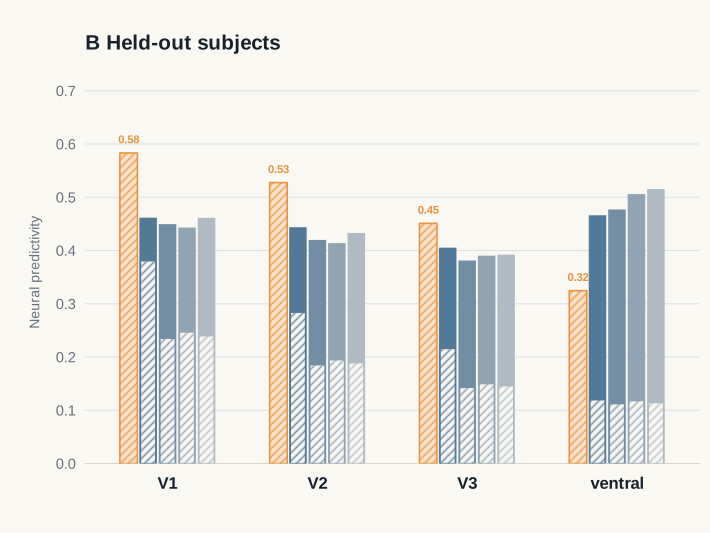
The searched model exceeds the best pretrained reference in V1, V2, V3, and hV4. Pretraining leads in the ventral aggregate. The same regional pattern remains visible in people held out from model search.
Pairs of Gabor filters preserve oriented structure while discarding local phase.
Local max pooling adds tolerance to small changes in position and scale.
Co-occurrence features summarize which local parts appear together.
10,601 reliable voxels · NSD subject 1
A computational gradient
The searched model’s predictivity declines along the cortical hierarchy. It leads the strongest pretrained reference through hV4, but not in the ventral aggregate.
Generalization
Across NSD and Triple-N, the latest evaluation separates people or macaques used during search from held-out subjects. TVSD repeats the test in a second macaque spiking dataset.
Three datasets · two species
NSD and Triple-N report noise-normalized explained variance. TVSD reports mean Pearson correlation. Values should be compared within a dataset, never across datasets.
Best pretrained references: ResNet-50 in V1; DINOv2 or CLIP in ventral cortex.
EVC contains one macaque per cohort. The best pretrained reference leads in IT.
Monkey F is the search animal. Monkey N is held out.
What comes next
The result is not the agent system. It is the discovered function: executable, testable, and interpretable as a hypothesis about cortical computation. We are now testing the same idea on language fMRI and intracranial recordings. Those results are preliminary and mixed, so they define a direction rather than a conclusion.